Oz, Smith visit Memorial Community Hospital
Published 2:19 pm Monday, October 12, 2026
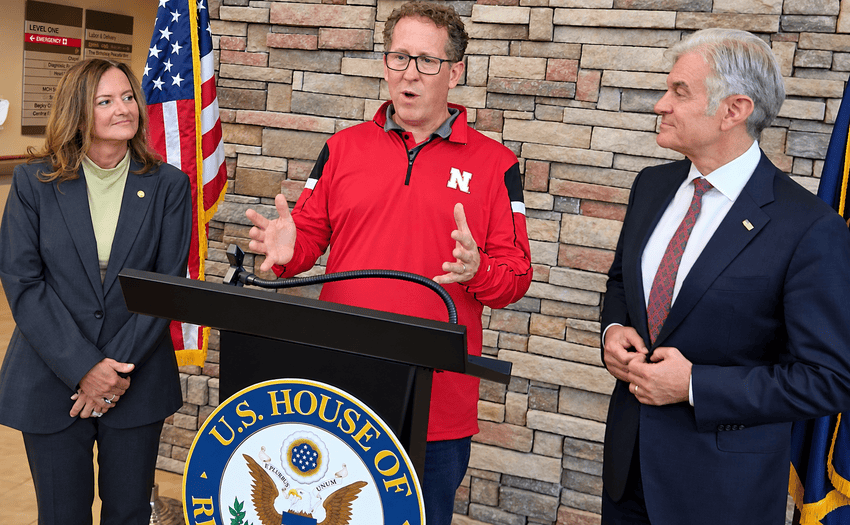
Dr. Mehmet Oz, administrator of the Centers for Medicare & Medicaid Services, and U.S. Rep. Adrian Smith, R-Neb., toured Memorial Community Hospital on Friday evening. The visit came a day before both were scheduled to attend the Nebraska football game in Lincoln.
According to a news release from Smith’s office, the two met with hospital staff to discuss challenges facing rural health care providers. Topics included telemedicine, rural health care workforce development and the Rural Health Transformation Program.
The group toured the facility with hospital leaders, including Manuela “Manny” Banner, president and CEO, and Dr. Mark Shirley, an emergency room physician. They then spoke to the media in the hospital’s front lobby. The press conference began about 6:40 p.m. and was restarted when a crew from WOWT arrived.
Banner said the hospital is near Omaha but serves a large rural area that includes Washington and Burt counties. “We may be located just outside of Omaha, but we’re very much a rural facility,” Banner said. “Every day, our team works to ensure that where someone lives does not determine the quality of health care they receive. Rural hospitals are more than buildings where people come when they’re sick. Across Nebraska, we’re all essential to the health, well-being and economic vitality of our communities.”
Banner said the hospital continues to expand services and invest in technology. “While we’re proud of what we accomplish here, we also know that workforce shortages, reimbursement challenges, regulatory requirements create real challenges for rural hospitals,” Banner said. “Decisions made in Washington have a direct impact on our ability to meet those challenges and build a sustainable future for rural health care. The challenges facing rural health care don’t recognize political boundaries, and neither should our commitment to solving them.”
Oz said he was amazed by what he saw during the tour. “A remarkably proficient group of individuals, passionate, and as we all know, you work well together, which is why you’re so successful,” Oz said.
Oz said some of the money from the Rural Health Transformation Program will go to the hospital. The program provides $50 billion to states over five years. “I’m blown away by your physical therapy, occupational therapy setup, which is really world-class,” Oz said. “And to have it in a critical access hospital is superb.”
Oz said the program puts 50% more money into rural health care than in the past. “It just so happens that rural America’s life expectancy, as you hinted at, it’s almost three years shorter than urban America,” Oz said.
Nebraska is set to receive $218 million this year. Oz said he hopes the state will receive funding for the following four years as well. “I’m hoping the states will exchange best practices and ideas, so the wisdom and the resilience you’ve shown here can be shared with hospitals all over the country,” Oz said.
Oz also addressed the program in the news release. “Rural health systems have been underfunded and under resourced for decades, but thanks to President Trump’s Rural Health Transformation Program, we’re empowering states to tackle that problem head-on by making the investments these communities need,” Oz said in the release. “I’m grateful to Congressman Smith for meeting with me and to Memorial Community Hospital for hosting us, so that together, we can discuss the improvements RHTP dollars are already driving and how additional funding can build on that progress over the remaining four years of the program.”
Smith said he is sponsoring the Main Street Pharmacy Access Act. The bill would allow Medicare to reimburse pharmacists who test and treat common illnesses, such as mild respiratory illnesses. He said Medicaid and private insurance companies already reimburse pharmacists for those services, but Medicare does not by law.
“My bill would propose that Medicare reimburses at 85% of what an M.D. would be reimbursed, but ultimately increasing access, that is so vital for the American people,” Smith said. “And we know that pharmacists, incidentally, are well deployed in many communities across America, both rural and urban.”
A WOWT reporter said some Nebraska hospitals want a portion of the rural health funding set aside for hospitals specifically, for technology upgrades and workforce recruitment. The reporter said some of the money is going to programs such as school meals and healthy food.
“I think it’s important that there’s flexibility provided,” Smith said. “I think it’s been a priority of the administration to not have Washington-based decisions on these funds, and that ultimately to encourage innovation, but also, like I said, to move the needle to get us to be a healthier country.”
Smith said there is always a question of whether grant money should go toward buildings. “Sometimes that can be a decent place, but oftentimes that’s not what can move the needle most effectively, most efficiently and help the most people,” Smith said.
He said hospitals can submit proposals. “It’s gonna be a different approach in different communities,” Smith said. “I mean, the 3rd District of Nebraska alone has more than 50 critical access hospitals. When you’ve toured one critical access hospital, you’ve seen one critical access hospital.”
The reporter cited $1.1 trillion in projected Medicaid reductions over the next decade. The reporter also asked about patients who may lose coverage because of new work requirements.
“There’s no cut happening in Medicaid. We’re adding 200 billion more dollars into Medicaid,” Oz said. “I only say that because it has been misconstrued as a cut to the program. That’s not what’s happening. What was going to happen, if you had not bravely, with your colleagues, passed legislation, is a massive increase in spending on Medicaid, much faster than other spending would have happened on other parts of health care, and that risked bankrupting the system.”
Oz said Smith and his colleagues in Congress “saved Medicaid.” “The key question is, is $200 billion more over the next decade enough?” Oz said. “And I can say that to make it enough, we have to improve the way we deliver quality care, because the most expensive thing we do in medicine is when you deliver poor quality care.”
Smith said the public overwhelmingly supports work requirements for Medicaid and the Supplemental Nutrition Assistance Program. “Certainly, our safety net is very valuable, and we want to help folks who cannot help themselves,” Smith said. “And looking to the future, work requirements are reasonable and appropriate and have huge support among the public.”
The reporter asked about Nebraska’s role in the November election. “I think all eyes are on the midterm elections,” Smith said. “At least I hope all eyes are on the midterm elections, because it’s important to get out and vote.”
Smith noted the president visited Nebraska earlier in the week. “When you see the importance of our work over the last two years, I would hate for us to lose, you know, to take steps backward,” Smith said. “I’m hearing from some colleagues who would love to do again what President Biden led on that really triggered inflation that we hadn’t seen in 40-some years.”
Oz was asked why he came to Nebraska. “Common sense is not so common, but it seems to still be common in Nebraska,” Oz said.
Amie Clausen, an Enterprise correspondent, is also president of the Blair Volunteer Fire and Rescue Department and an EMT. She told Oz and Smith the department handles about 1,500 calls a year. About 80% are rescue calls, and most of those patients are taken to Memorial Community Hospital. She said that while serving on a squad in Randolph, she made transports of 35 to 45 minutes to a hospital while performing CPR.
“I want you to know from us, as your emergency medical responders out there in the field, how important it is that we get the funds to these rural hospitals, because they need us and we need them,” Clausen said. She said EMT training takes 120 hours and costs some people $3,000.
Smith said coordination with emergency responders is a focus. “That coordination and communication that is so vital, and looking for new ways and methods, we wanna focus on that as well,” Smith said.
In the release, Smith said critical access hospitals play a vital role in their communities. “I look forward to continuing to work together to strengthen rural healthcare and ensure every Nebraskan has access to quality care, regardless of their ZIP code,” Smith said in the release.
Banner said in the release that the visit gave providers a chance to be heard. “These conversations help ensure that rural voices are heard and that policy decisions reflect the realities facing rural healthcare, allowing us to continue providing high-quality care close to home,” Banner said in the release.
After the event, the group went to Runza in Blair. Clausen said it was Oz’s first Runza.